
Japandi desk setup ideas
Six elements that combine Japanese minimalism with Scandinavian warmth — and the principles that hold the line between restrained and clinical.
Japandi sits in the most interesting position in the aesthetic landscape — it's where Japanese minimalism meets Scandinavian warmth, where restraint meets hygge, where the discipline of less meets the comfort of natural materials. Japandi combines Japanese minimalism with Scandinavian warmth into a single coherent design language. It isn't a compromise between two styles. It's a third style that uses both as ingredients.
A Japandi workspace enhances mindfulness and productivity in a way few aesthetics manage. The Japanese side keeps the surface uncluttered and the materials honest. The Scandinavian side keeps the warmth in the wood, the textile, and the light. Together they produce a desk that's calm without being cold, intentional without being precious. Intentional living is emphasized in Japandi design — every object earns its place through function or meaning, and visual noise stays low so focus stays high.
Japandi emerged in the 19th century from cultural exchanges between Scandinavian designers and Japanese craftspeople, and that cross-pollination still shapes the aesthetic today. The two cultures share more than they look like at first glance — both prize craft over excess, both treat natural materials as worthy of display rather than concealment, both build for longevity rather than novelty. Hygge emphasizes warmth, coziness, and comfort in design; wabi-sabi appreciates beauty in imperfection and transience. Japandi is what happens when those values guide every decision at the desk.
I rebuilt my own desk three times trying to get Japandi right. The first version was too minimalist — clean but cold. The second was too cozy — warm but cluttered. The third worked when I stopped thinking of it as “minimalist plus cozy” and started thinking of it as its own discipline with its own rules.
This guide covers the six elements that consistently make a desk read as Japandi, the five principles that hold the line between restrained and clinical, the gear that earns its place, and the mistakes that quietly ruin the aesthetic even when everything else is right.
What actually makes a desk Japandi
The six elements below look different individually, but they work because they share these five underlying rules. Get these right and the elements compound. Skip one and the whole composition slides toward either sterile minimalism or busy cozy — both close to Japandi, but neither it.
- 01
Restraint, not removal
Japandi isn't about subtraction for its own sake. Japandi style combines Japanese and Scandinavian design elements, and the warmth comes from what stays — wood grain, ceramic texture, paper light, woven fiber. The desk feels alive because what's on it is real and considered, not because there's a lot of it. Japandi style emphasizes functional furniture with clean lines, and every object that survives the edit should be both useful and beautiful.
- 02
Wabi-sabi is the design language
Wabi-sabi appreciates beauty in imperfection and transience, and it's a key principle of Japandi design philosophy. A handmade ceramic mug with a slightly uneven rim, a wood desk with visible knots, a natural stone coaster with rough edges — these add character and charm without adding visual noise. The opposite is mass-produced perfection: glossy plastic, identical chrome, factory-perfect symmetry. The discipline is choosing objects that age into beauty rather than out of it.
- 03
Ma is the most important object on the desk
Embrace the Japanese concept of Ma in design by using negative space. The empty third of the desk isn't laziness — it's design. Negative space carries weight in Japandi the way no other element does. Natural light should be maximized so the empty surface gets to breathe. If the desk doesn't have visible empty space, it isn't Japandi yet, regardless of what else is on it.
- 04
Natural materials in three places, minimum
A Japandi desk with wood once and synthetic everywhere else doesn't feel Japandi — it feels like a wood desk with stuff on it. Natural materials like wood are essential in Japandi design, but the discipline is repetition. Wood in the desk, ceramic in the vessel, linen in the textile, paper in the lamp, jute underfoot — at least three natural materials and natural fibers present, working together. Japandi design values natural materials and organic textures because they carry color and texture in a way no synthetic substitute can.
- 05
One accent at a time
Japandi favors a neutral and earthy color palette with one disciplined accent. A single dark-charcoal lamp base. A single terracotta planter. A single deep-walnut frame. Two accents in different colors and the discipline breaks; one accent in one color and the whole desk reads as intentional. Decluttering and organization are important in Japandi workspaces, and that includes the discipline of color — if you want variety, rotate the accent seasonally rather than letting them accumulate.
Six elements that build a Japandi desk
Each element below contributes a specific quality to the aesthetic. Layer four of them and you've got Japandi. Layer all six and the room transforms into the kind of calm, intentional workspace the style is known for.
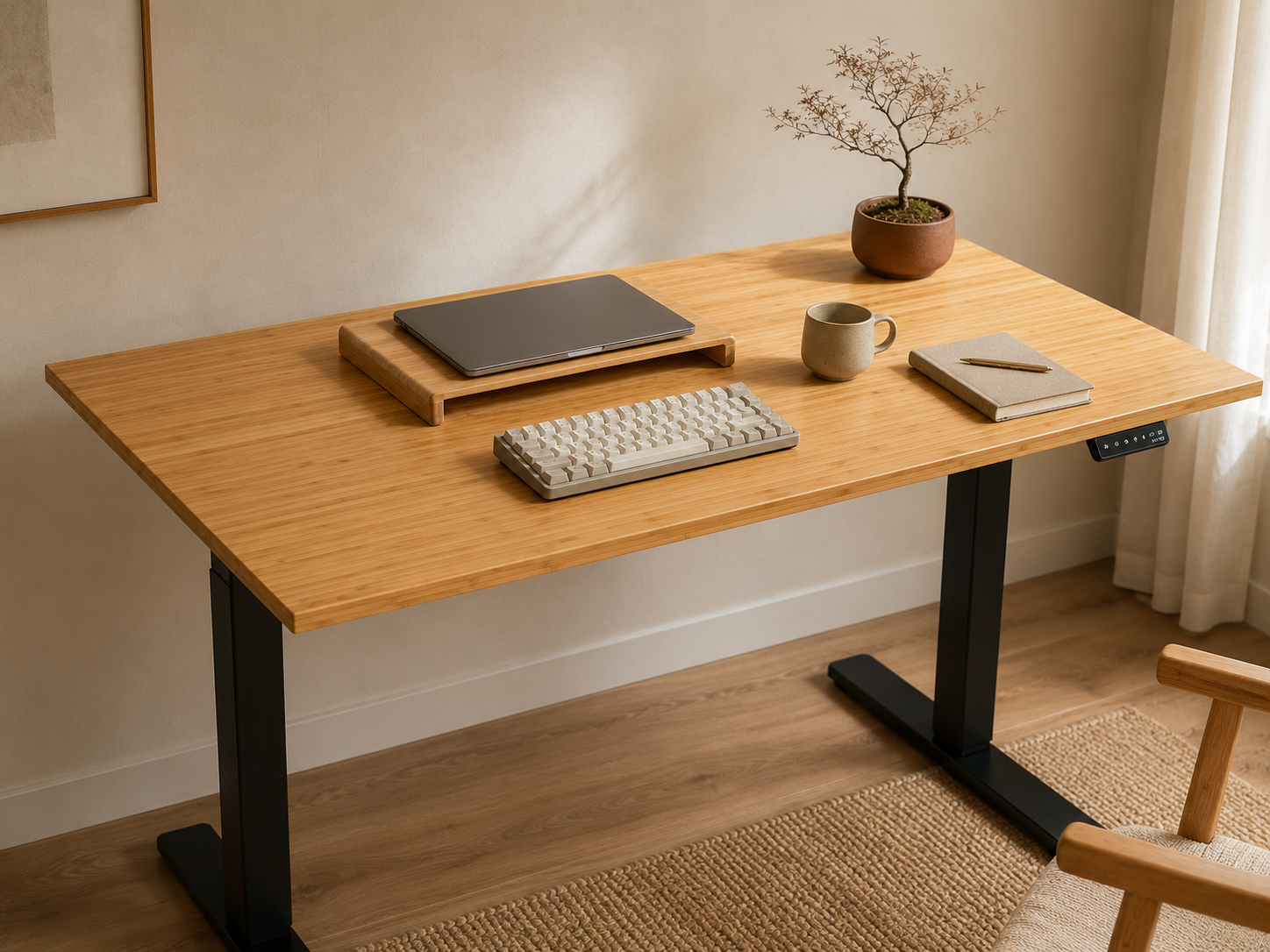
Natural Wood Foundation
The desk itself matters more in Japandi than in any other aesthetic. Natural materials like wood are essential in Japandi design — solid oak, ash, birch, or bamboo for the surface, with visible grain and a matte or natural-oil finish rather than glossy varnish. Japandi desks often feature a mix of light and dark wood, with lighter woods on the desk surface and darker walnut or charcoal-stained accents elsewhere in the zone. The wood grain is what your eye lands on first; everything else builds around it.
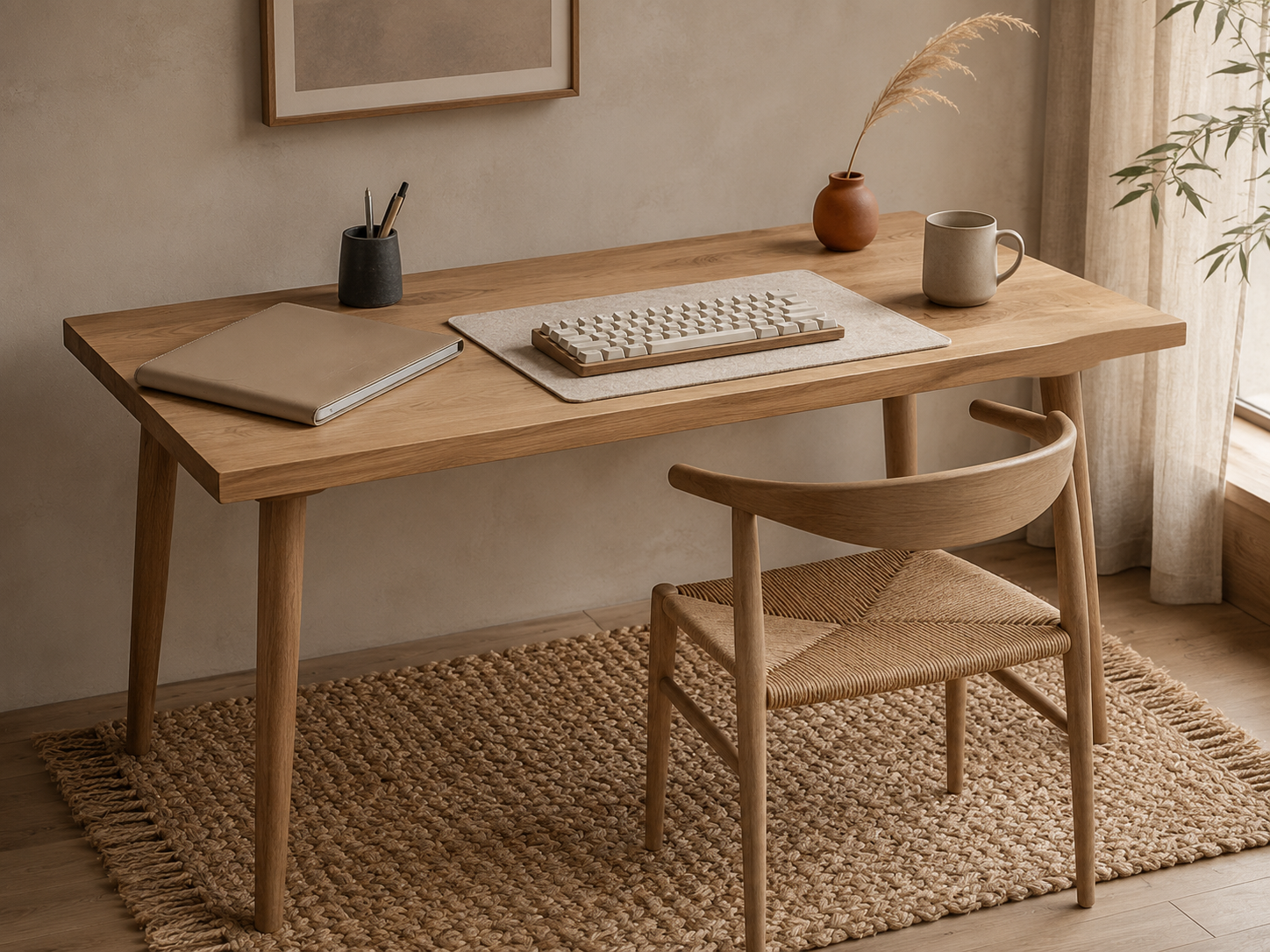
Earthy Neutral Palette
Japandi emphasizes natural materials and earthy color palettes. The core: warm white, oatmeal, greige, mushroom, clay. The accent: deep charcoal or terracotta — one accent color used sparingly across the zone. Earthy hues like terracotta and charcoal grey are popular in Japandi setups for good reason: they ground the space without competing with it. Neutral hues let the wood grain and material textures do the visual work, and the palette should flow across desk, walls, textiles, and accessories so the whole zone reads as one cohesive space.
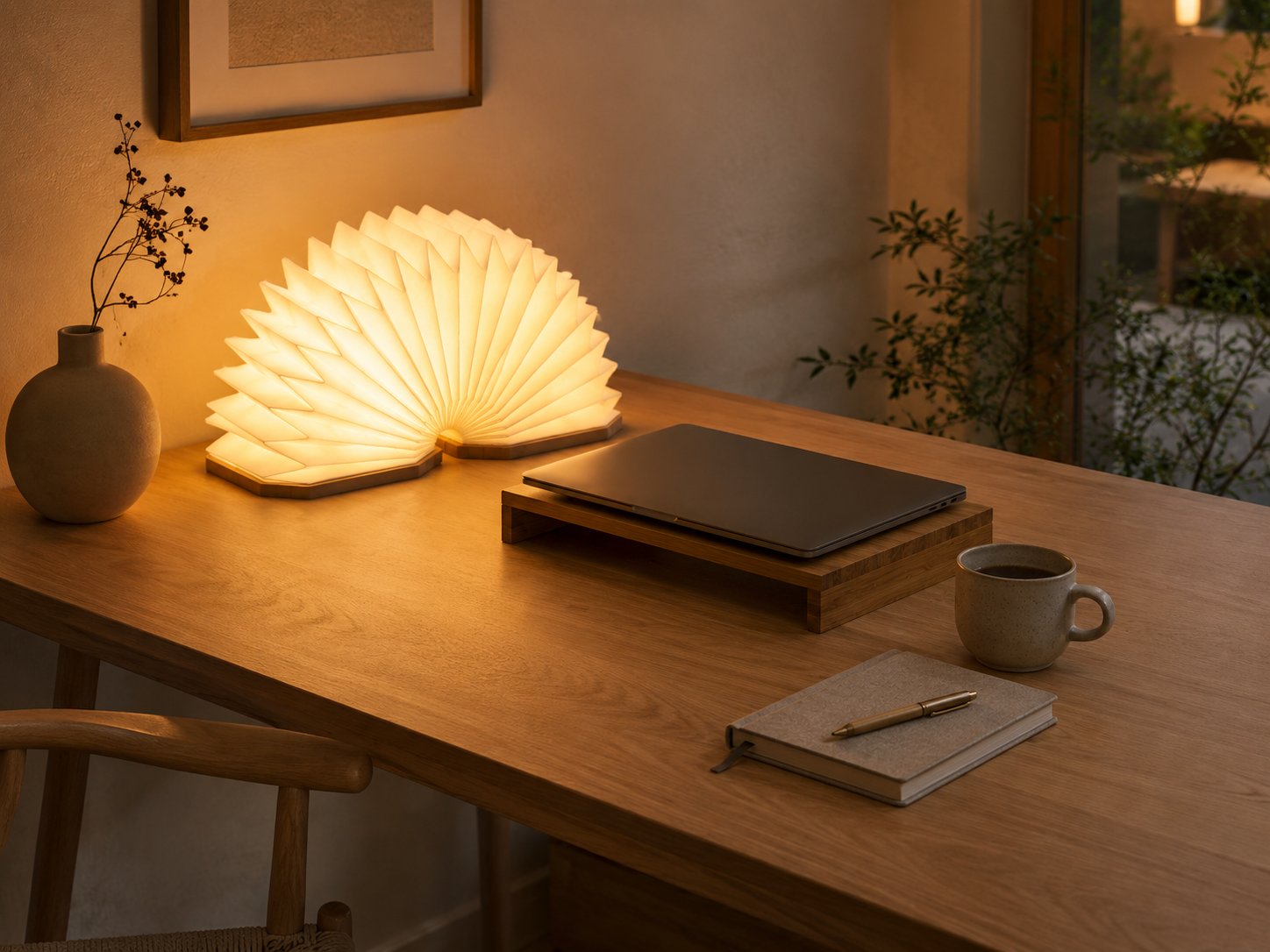
Paper Lamps & Soft Diffused Light
Soft lighting is preferred in Japandi designs to create a tranquil atmosphere. The signature Japandi light source is the paper lamp — table or floor versions inspired by Japanese shoji screens that diffuse light through translucent paper. Pair with warm white bulbs at 2700-3000K. Layer with natural daylight from the side during the day and a single floor lamp behind the chair in the evening. Paper lamps echo the same craft tradition as the desk itself — handmade, honest, and quietly beautiful. The airy feel they produce is unmistakable.
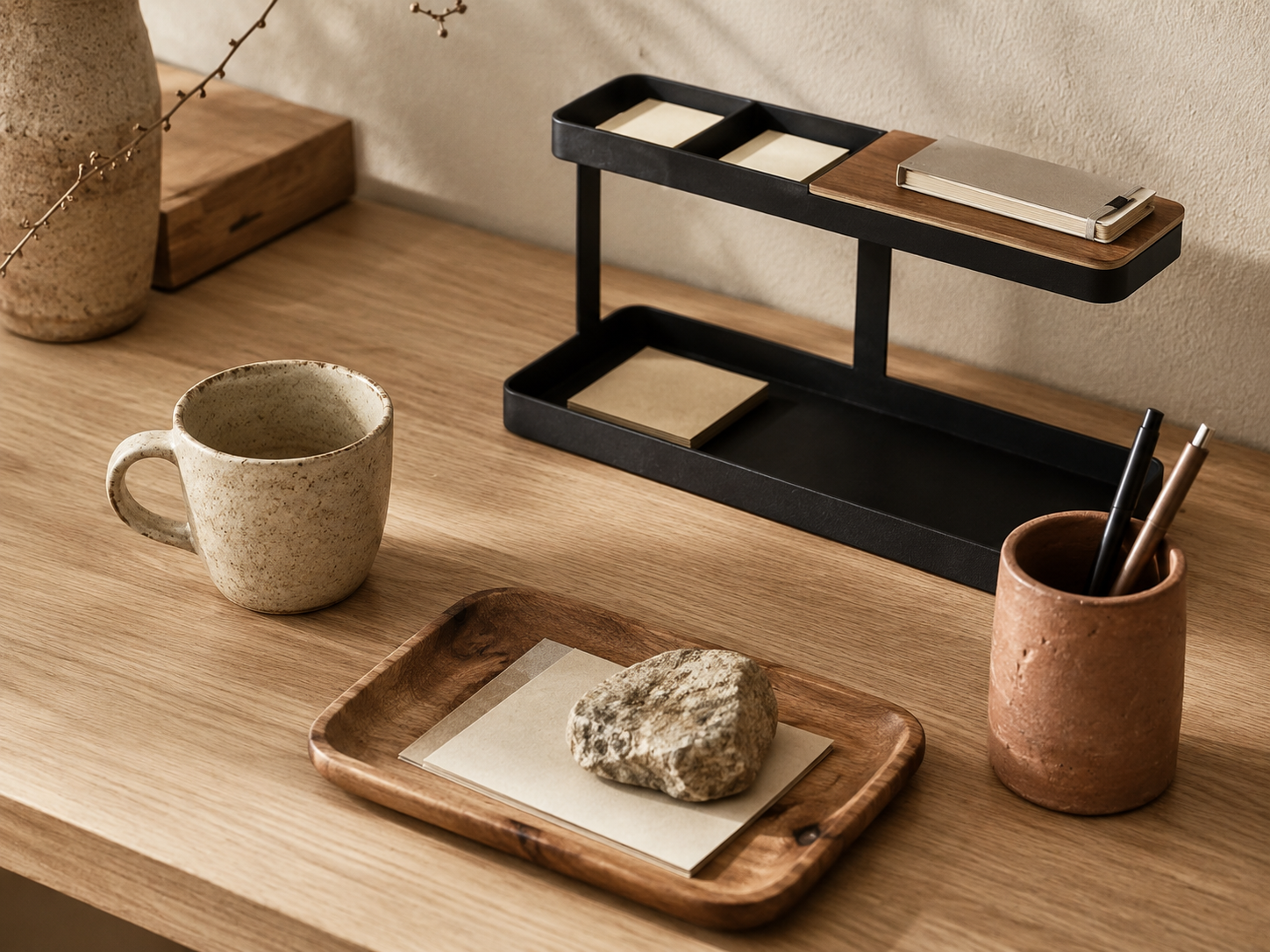
Wabi-Sabi Objects
Wabi-sabi appreciates beauty in imperfection and transience, and it's a key principle of Japandi design philosophy. The objects on the desk should show their origin — a handmade ceramic mug with visible throwing marks, a stoneware pen cup with an uneven glaze, a wood tray with grain irregularities, a piece of natural stone with rough edges. These objects add character and charm without adding visual noise. The opposite of wabi-sabi is mass-produced perfection — glossy plastic, identical chrome, factory-perfect symmetry. Japandi rejects all of it in favor of objects that look like a human made them.
Plants & Sculptural Nature
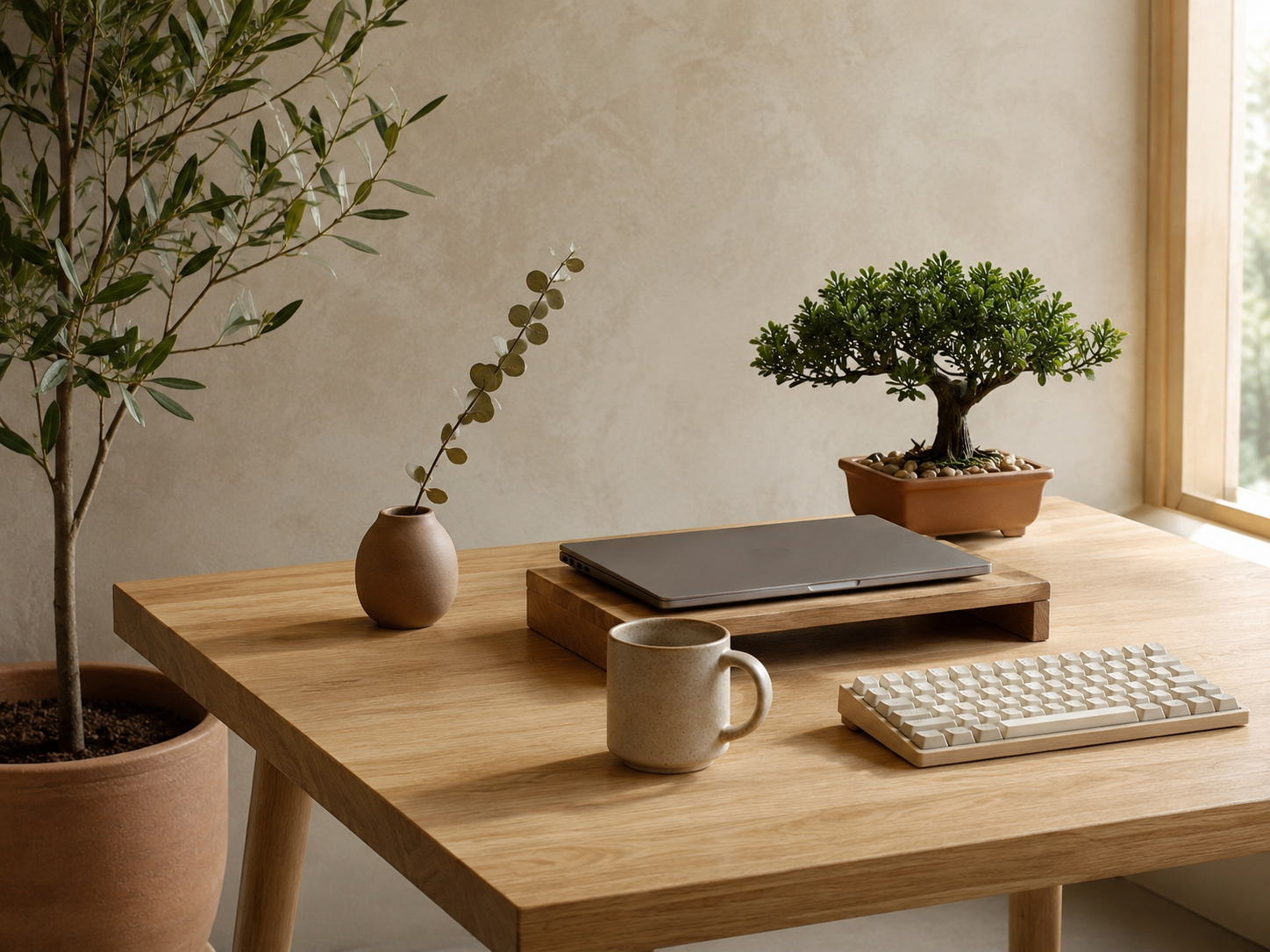
Incorporate plants to bring nature into a workspace. Plants like olive trees enhance the natural look of a Japandi office when placed on the floor nearby, while a small bonsai or sculptural branch arrangement adds architectural energy on the desk itself. Add indoor plants like bonsai or sculptural branches in Japandi designs for visual interest without color saturation. Choose planters in unglazed terracotta or matte ceramic — never plastic. For low-light rooms, dried grasses or preserved eucalyptus work as beautiful alternatives that don't require care.
Negative Space (Ma)
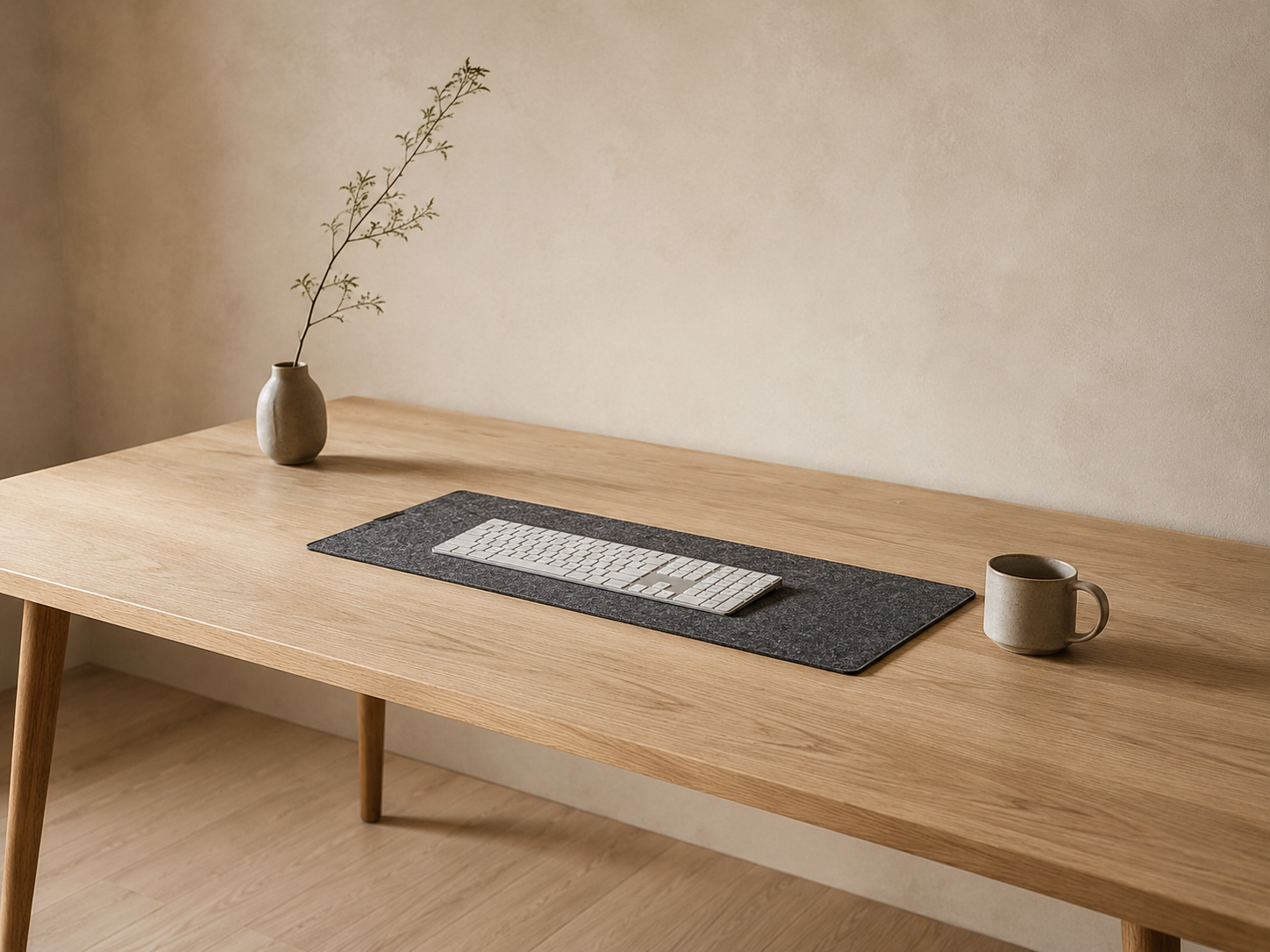
This is the discipline that distinguishes Japandi from cozy. Embrace the Japanese concept of Ma in design by using negative space — leave at least one third of the desk surface visually empty. The empty space isn't waste; it's what lets the other elements breathe. Clutter-free minimalism helps reduce decision fatigue in workspaces, and that effect compounds when the space is deliberately empty rather than accidentally so. If the desk feels crowded even with only five objects on it, the problem is layout, not count — spread them out and let the wood show through.
Six pieces of gear that build a Japandi desk
Every piece below earns its place through natural material, honest craft, or functional restraint. Each one solves a specific Japandi problem — none are filler.
Some links in this section are affiliate links. If you buy through one of them, we may earn a small commission at no extra cost to you. We only recommend gear we'd use ourselves.
Uniwolk Bamboo & Paper Lantern Desk Lamp
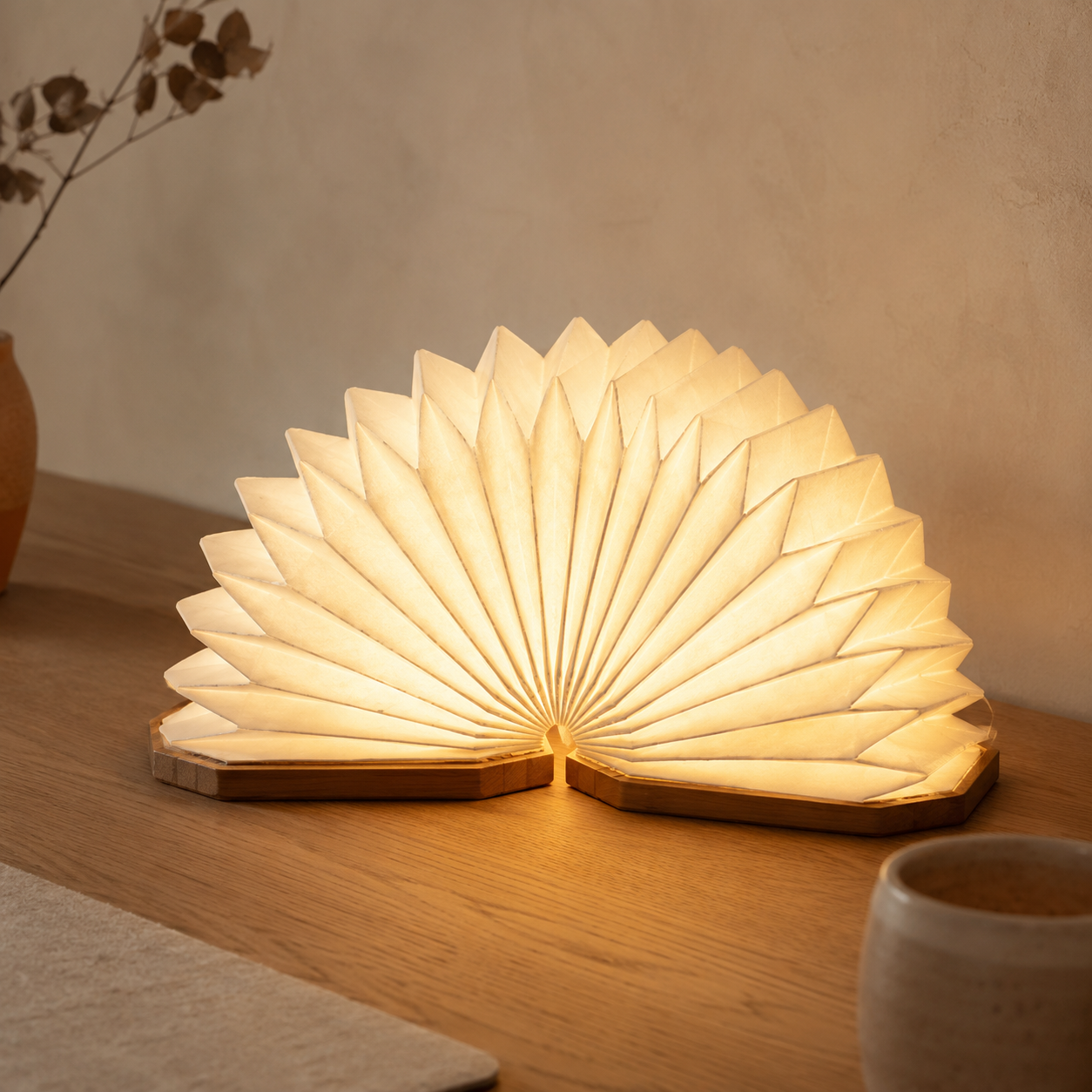
The rare two-material product that hits both halves of Japandi at once — a solid bamboo base paired with a translucent rice-paper shade. The bamboo echoes the desk surface; the paper diffuses warm light through the same craft tradition as a Japanese shoji screen. Soft lighting is preferred in Japandi designs to create a tranquil atmosphere, and this lamp delivers it for a fraction of the cost of a Noguchi Akari.
- Solid bamboo base with visible grain
- Translucent rice-paper shade diffuses light gently
- Compatible with standard warm-white LED bulbs
Flexispot E7 Pro Bamboo Standing Desk
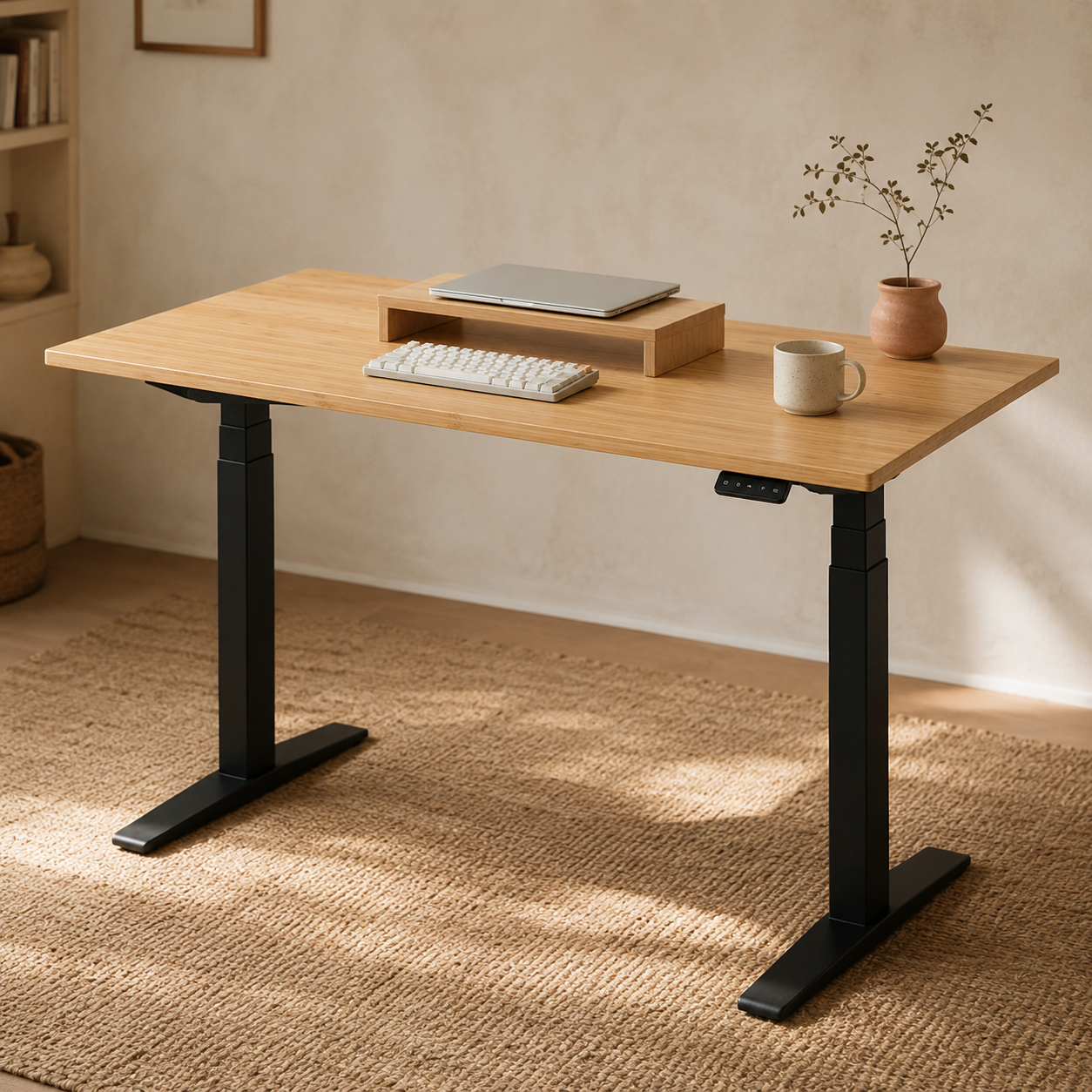
The motorized desk most worth its money — with the bamboo top option that turns it from a generic standing desk into a legitimate Japandi foundation. Bamboo carries the same visible grain and matte finish as solid oak at a fraction of the cost, and the dual motors handle the height transition smoothly without straining under monitors and accessories.
- Solid bamboo top with visible grain (multiple sizes)
- Dual-motor base, 22″-48″ height range
- 4 memory presets, anti-collision sensor
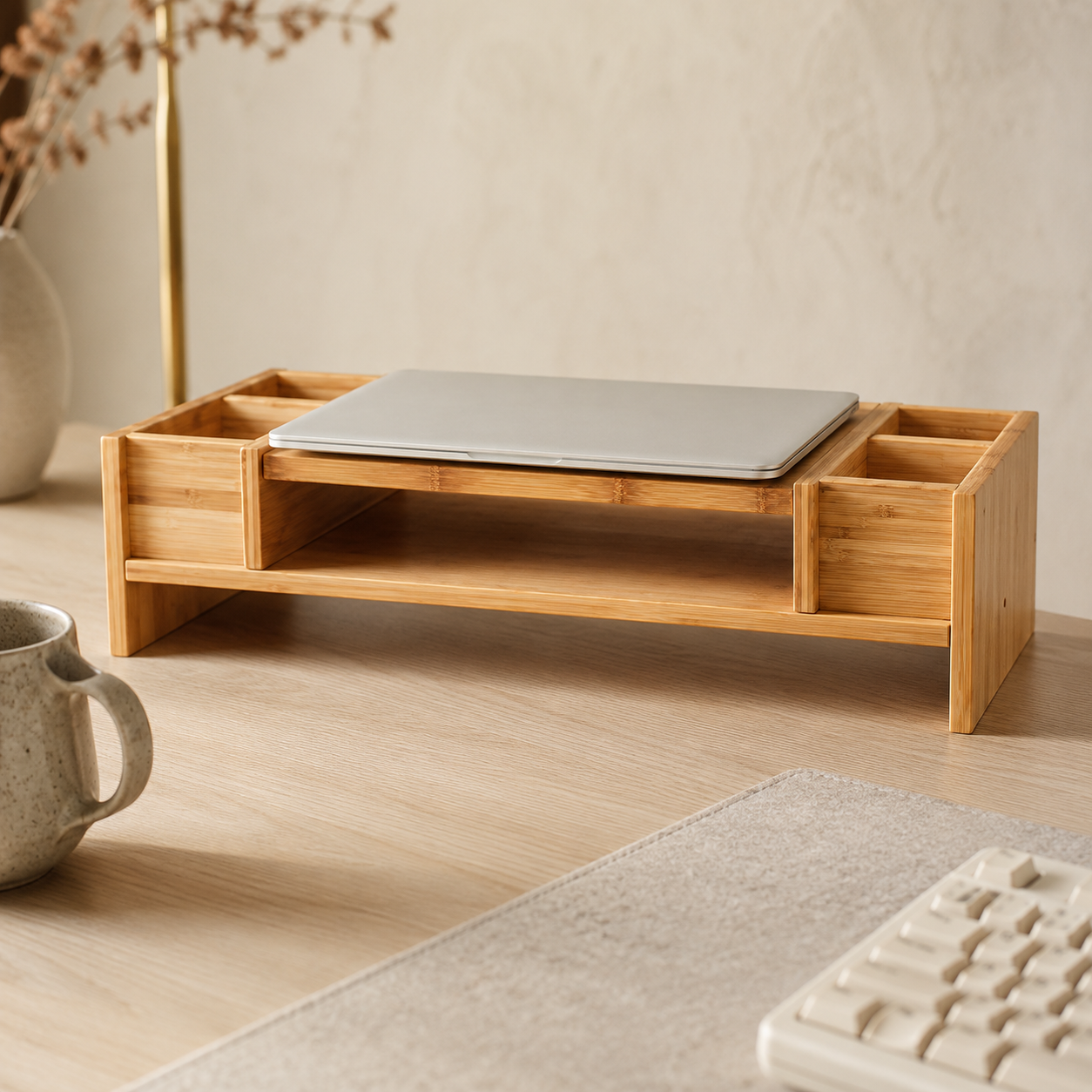
Songmics Bamboo Monitor Stand Riser
Elevates the monitor to ergonomic eye level while contributing a second natural material to the desk zone. The bamboo grain echoes the desk top, reinforcing the rule of repetition that holds Japandi together. Has a small storage compartment underneath for documents or a notebook — functional without breaking the visual calm.
- Solid bamboo construction, not laminate
- Holds monitors up to 44 lbs
- Small storage compartment beneath
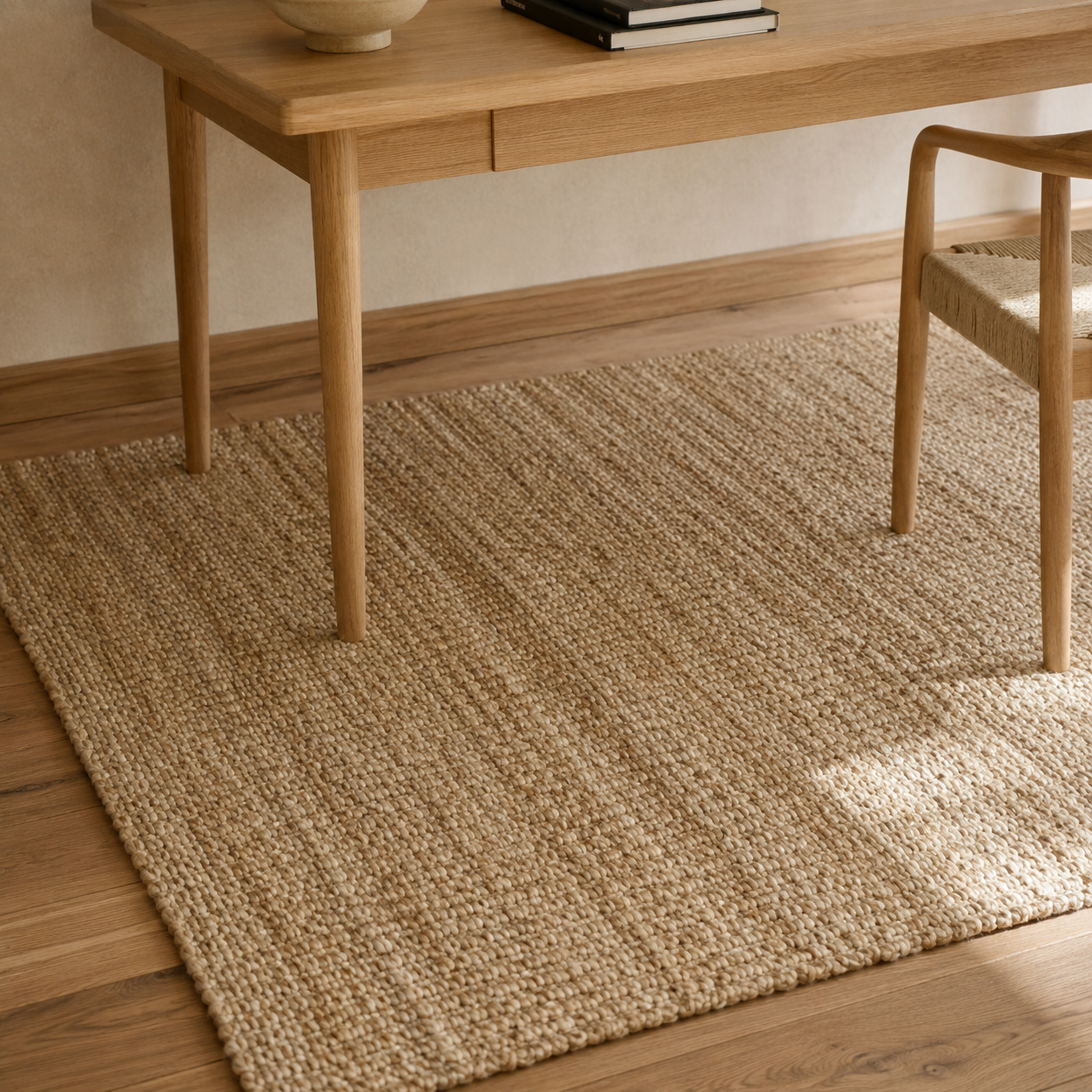
Safavieh Natural Fiber Jute Rug
A jute rug complements wood and rattan furniture in Japandi design — the woven natural fiber sits beautifully beside any wood desk and adds texture underfoot without competing visually. The earthy oatmeal tone reinforces the palette rather than introducing a new color. Available in multiple sizes; pick one large enough to extend beyond the desk on both sides.
- 100% natural jute fiber
- Multiple sizes from accent to large area rug
- Sits naturally on hardwood, low-pile profile
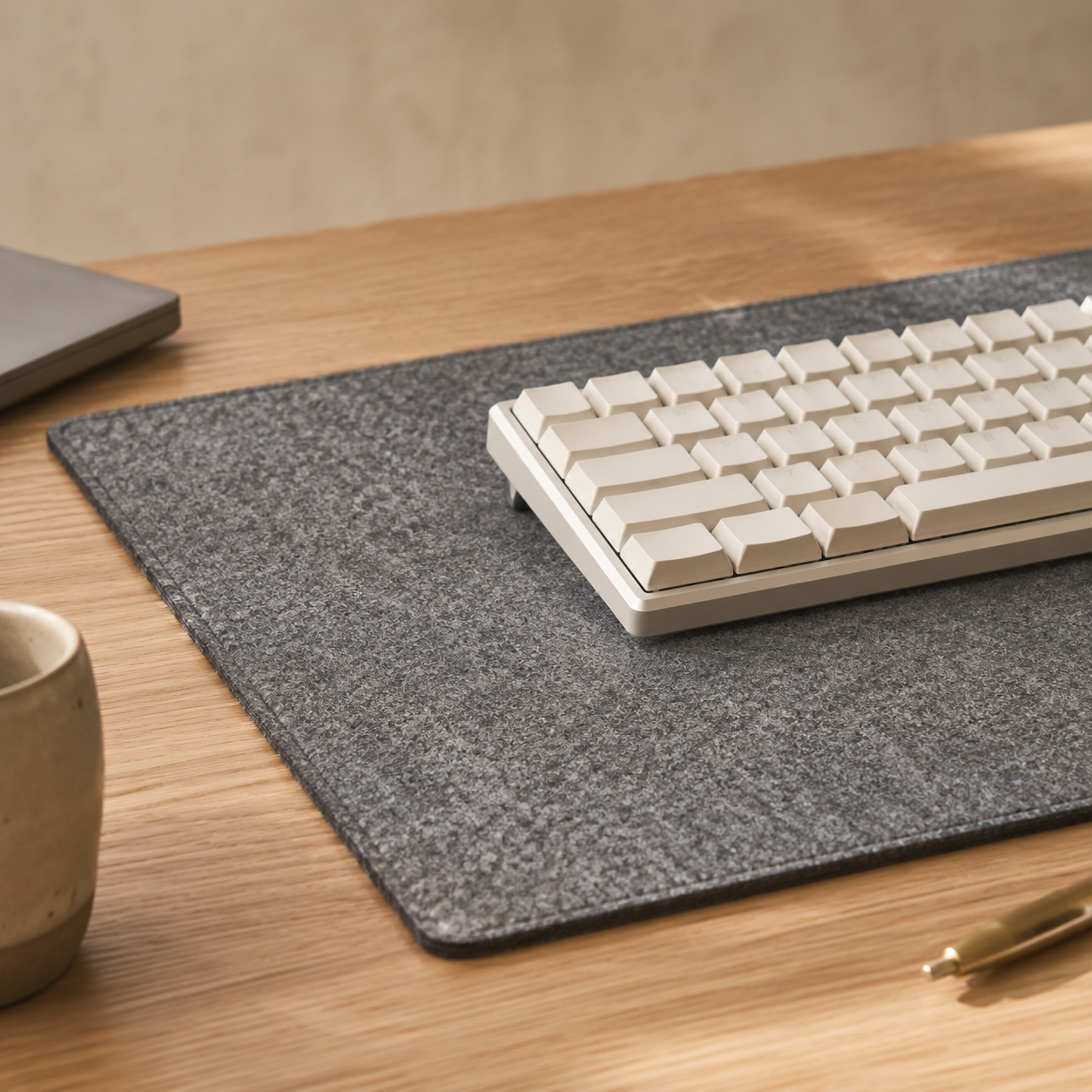
Grovemade Wool Felt Desk Pad
A wool felt desk pad in oatmeal or warm gray that contributes a third natural material to the desk zone — wood, jute, and wool, all working together. The thick felt softens keyboard sound and protects the desk surface while adding tactile warmth. Available in earthy-palette colors that suit the Japandi neutral range exactly.
- 100% wool felt, 4mm thick
- Multiple sizes and earthy color options
- Dampens keyboard noise as a bonus
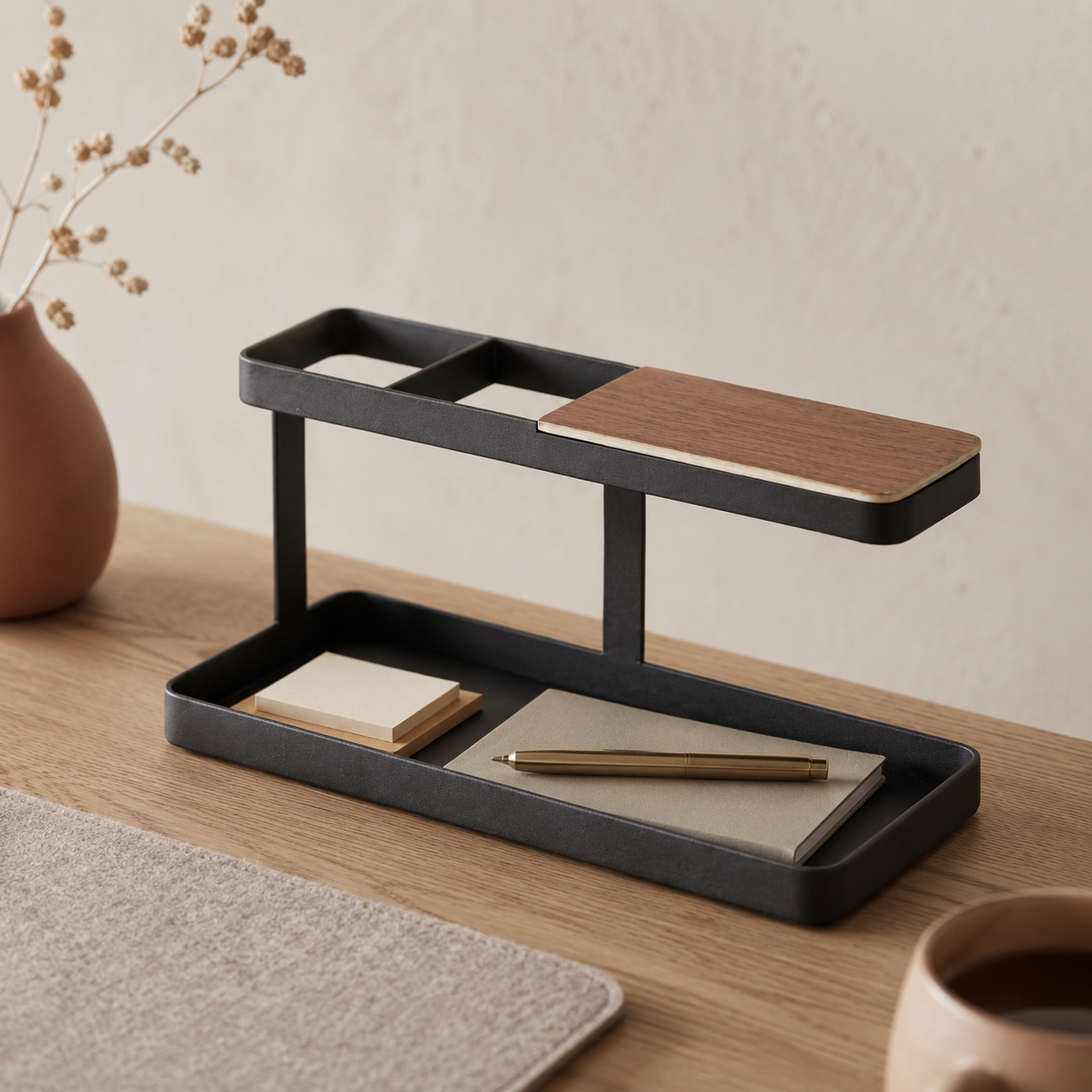
Yamazaki Tower Desk Organizer
A Japanese-designed minimalist desk organizer from Yamazaki's Tower line. Clean lines, matte finish, and small footprint — it holds the items that would otherwise scatter across the surface (pens, sticky notes, small notebook) and keeps them visually contained. Available in matte white and black; both fit a Japandi palette as a single disciplined accent.
- Steel construction with matte powder-coat finish
- Compact footprint, multiple compartments
- Designed in Japan by Yamazaki Home
Four ways Japandi desks go wrong
Most Japandi attempts that don't land are failing on these four predictable mistakes. Catch them and the setup straightens itself out.
- 01
Treating Japandi as “minimalist plus cozy”
Japandi isn't a combination of two other styles — it's its own discipline with its own rules. The temptation is to start minimalist and add warmth, or start cozy and remove stuff. Both approaches produce something that feels confused. Start with Japandi principles (wabi-sabi, ma, natural materials, restraint) and build from there. The aesthetic exists because the Japanese and Scandinavian traditions already share values — you're not blending two opposites, you're working with a tradition that emerged from cross-pollination.
- 02
Wrong wood = wrong everything
A walnut desk reads cozy, not Japandi. A laminate “wood-look” desk reads sterile, not Japandi. A glossy lacquered desk reads modern, not Japandi. Japandi needs visible real wood grain in the light-to-medium range — oak, ash, birch, bamboo, light pine, with a matte or natural-oil finish. If the desk material isn't right, no amount of accessorizing fixes it. This is the single most expensive mistake in a Japandi build and the one that's hardest to recover from.
- 03
Buying for the photo, not the use
Japandi photographs beautifully — paper lamps, bonsai, ceramic vessels — and it's easy to assemble a stunning vignette that's miserable to actually work at. Make sure the chair is genuinely comfortable, the monitor sits at proper ergonomic height, and the lighting actually illuminates the work. The aesthetic should reward daily use, not punish it. An interior designer would tell you the same thing: photogenic and functional are two different briefs, and Japandi is only worth building if it serves the second.
- 04
Too many “accent” pieces
Japandi favors one accent at a time. Once there are two charcoal objects, three ceramic vessels, and four wood textures, the discipline is gone — the desk slides from Japandi into busy-but-earthy, which isn't the same thing. Decluttering and organization are important in Japandi workspaces. Pick the single accent and rotate it seasonally if you need variety. The Japanese tradition of seasonal rotation (changing the alcove display, the scroll, the tea bowl) is itself part of the philosophy — use it.
Japandi desk questions, answered
What is a Japandi desk setup?
A Japandi desk setup combines Japanese minimalism with Scandinavian warmth into a single coherent design language. Japandi style emphasizes functional furniture with clean lines, natural materials, and an earthy color palette. The defining elements: a solid wood desk in light oak or bamboo, paper or linen-shaded lighting, ceramic vessels, jute or wool textiles, and intentional negative space on the surface. The result is a calm, intentional workspace that supports focus without feeling sterile.
How is Japandi different from minimalist or cozy?
Minimalist is about subtraction — remove everything that doesn’t earn its place. Cozy is about layering — add warm light, soft texture, plants, and personal decor. Japandi is the middle path: restraint plus warmth, restraint plus craft. A Japandi desk has fewer objects than a cozy desk but more material variety than a minimalist one. The warmth comes from the materials themselves (wood, ceramic, linen, paper) rather than from layered textiles or accumulated decor.
What’s the best lighting for a Japandi desk?
Soft lighting is preferred in Japandi designs to create a tranquil atmosphere. The signature is a paper-shade table lamp inspired by Japanese shoji screens — Noguchi Akari lamps are the iconic original, with HAY, Aukoma, and Brightech offering more affordable options. Pair with warm white bulbs at 2700-3000K. Layer multiple soft sources: a paper lamp on the desk, a floor lamp behind the chair, natural daylight from the side. Avoid harsh overhead lighting and cool-toned LEDs entirely.
Can a Japandi setup work in a small apartment?
Yes — Japandi is one of the most space-efficient aesthetics because its discipline favors fewer, better objects. For tight rooms, choose a narrow desk (80-100cm wide is enough), a single paper lamp instead of multiple light sources, and a small bonsai or sculptural branch instead of a floor plant. The palette restraint also makes small spaces feel larger because there’s no visual fragmentation. Japandi originated in the 19th century with cultural exchanges that often took place in compact urban interiors, so the style is built for small-space living.
What materials are essential for a Japandi desk?
Wood (the desk itself, ideally light oak, ash, birch, or bamboo), ceramic (vessel, mug, pen cup), paper (lamp shade), linen or wool (textile element), and jute (rug underfoot). Japandi design values natural materials and organic textures — synthetic substitutes (plastic, vinyl, glossy laminate) break the aesthetic regardless of color. Repeat at least three of these materials within the desk zone for the look to feel cohesive rather than accidental.
What colors should I use for a Japandi desk?
Japandi favors a neutral and earthy color palette. The core: warm white, oatmeal, greige, mushroom, clay. The accent: deep charcoal or terracotta — one accent color used sparingly across the zone. Earthy hues like terracotta and charcoal grey are popular in Japandi setups because they ground the space without competing with it. Avoid saturated brights, glossy whites, and pure blacks. The palette should feel like it was pulled from natural materials (wood, clay, stone, linen), not from a color swatch book.
The best new setups, in your inbox
One thoughtful email. No spam, no fluff.